Feed & spread
Present an even material flow to the rotating disc deck.
Separate fines by size and condition the material burden before optical sorting. A mechanical first step towards a more stable line.
 AISORT / 06ROBOTICS & SUPPORT SORTING
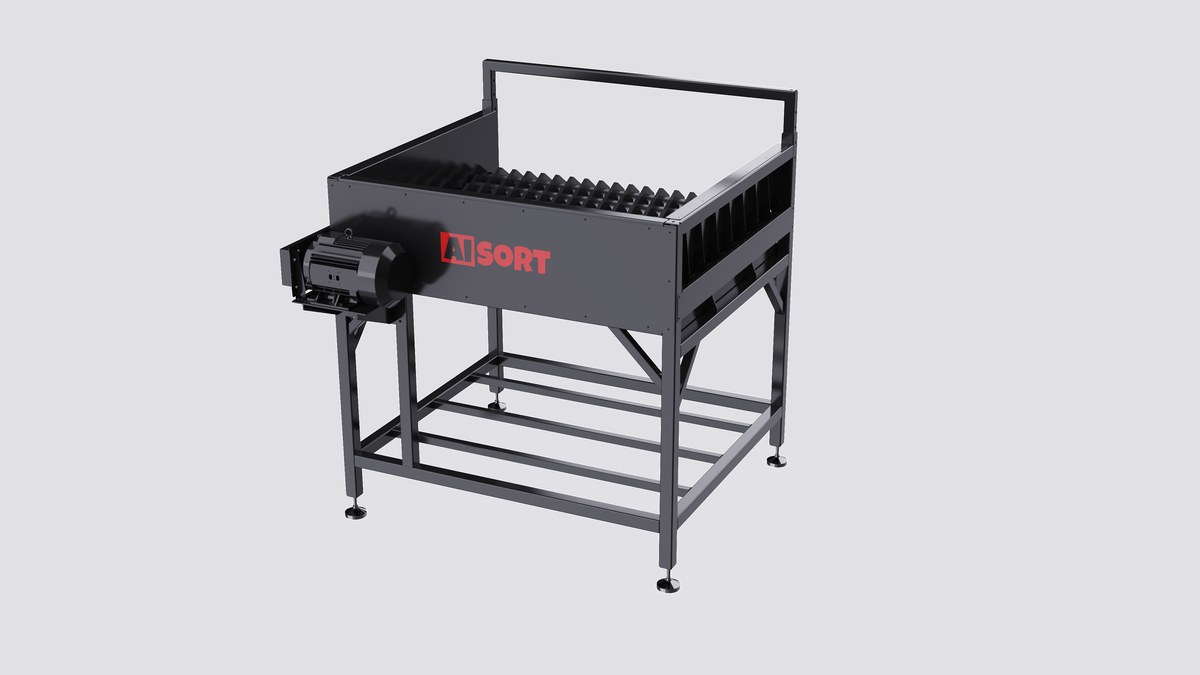
Rotating discs divide the feed by size. Fines fall through the deck while oversize material moves onwards, reducing the burden on downstream optical equipment. The screen separates by size rather than polymer type.
Rotating discs separate fines from larger material while conveying the feed, preparing it for downstream sensing and sorting. Confirm the screening configuration against size distribution and contaminants, together with conveyor interfaces, cleaning and maintenance access.
Remove fines and condition the burden before the material reaches a sensor.
Configure the aperture and deck around the intended size cut and downstream equipment.
Replaceable disc components and accessible mechanical construction support routine maintenance.
Present an even material flow to the rotating disc deck.
The configured gap allows the undersize fraction to pass through.
Larger material continues towards optical sorting.
The undersize fraction leaves through its own collection route.
Final equipment selection and operating parameters depend on your feedstock, target fractions and site conditions.
Request technical information ↗| Equipment type | Rotating disc screen for coarse size separation |
|---|---|
| Line position | After bag opening and dosing, before optical sorting |
| Screen aperture | Selected for the required cut point at line survey |
| Deck configuration | Single or multi-stage, depending on how many cuts the line needs |
| Drive | Electric geared drive with overload protection |
| Capacity | Determined by aperture, deck width and feed bulk density - confirmed per project |
| Construction | Wear-resistant deck components with replaceable discs |
| Integration | Standalone module or retrofit into an existing conveyor line |
Explore the equipment
from another angle.
No. A disc screen separates material by size only. It does not identify polymer type, colour or shape, and it cannot produce a saleable mono-material output on its own.
The cut should follow the smallest item the optical stage is expected to recognise and eject reliably, not a generic rule of thumb.
It handles it, but capacity drops and the aperture choice becomes more critical. Wet and fibrous material tends to blind the gaps and reduce open area.
Usually yes, provided there is floor space and enough headroom for the discharge conveyor. The constraint is layout, not the machine itself.
Share your feedstock, recovery targets and plant layout. Build the next step with an AISORT engineer.
Talk to sales engineering ↗