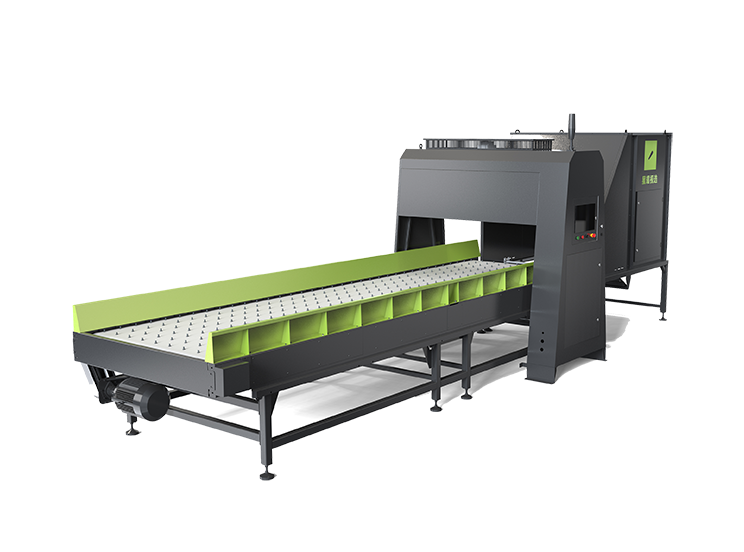
Sorting System Retrofit
A constraint-led upgrade route for plants improving throughput, purity and labour economics without replacing the whole line.
Quick answer
When a sorting retrofit is the better choice
Quick answer: choose a retrofit route when the plant still has a usable mechanical backbone, but throughput, purity, labour dependence or control logic no longer support the commercial target.
A retrofit is strongest when the economic problem can be solved by upgrading the sorting architecture instead of replacing the whole line.
Main objective
Upgrade without rebuild
Useful when the plant wants commercial improvement without full greenfield replacement.
Typical trigger
Purity or labour gap
Retrofit is often justified when output quality or labour dependence is the main business bottleneck.
Critical check
Existing line condition
The current conveyor, utilities and process logic must still be strong enough to build on.
Decision style
Constraint-led
Retrofit design starts from physical and operational constraints, not from catalogue preference.
How to decide between retrofit and replacement
1. Check whether the line backbone is still usable
If conveyors, mechanical separation and utility routing are still sound, retrofit often remains commercially attractive.
2. Identify the true limiting stage
Retrofit is strongest when one or two sorting stages are limiting commercial performance. If the entire flow is unstable, a broader redesign may be more appropriate.
3. Measure downtime tolerance
Retrofit planning must account for shutdown windows, changeover sequence and how much production interruption the plant can absorb.
4. Compare total project risk, not only capex
A lower capex retrofit may still be the wrong answer if it cannot deliver durable line economics. The decision should weigh performance risk, downtime risk and future expandability together.
Where retrofit usually creates value
Throughput upgrades
Useful when the line must move more material without rebuilding the full plant.
Purity improvement
Strong fit when the existing line produces volume but not enough downstream acceptance.
Labour reduction
Relevant where manual sorting is the unstable or expensive layer in an otherwise usable line.
Modular expansion
Useful when the plant wants a staged capital path rather than one large replacement event.
When retrofit is not the right answer
Retrofit is not the right answer if the existing process backbone is already too unstable, too constrained or too mismatched to the target output. In those cases, staged upgrade logic may only postpone a bigger redesign decision.
- Do not retrofit a line that cannot physically support the new process intent.
- Do not assume “less downtime” means “less total project risk”.
- Do not compare retrofit only on capex without considering downstream performance.
Industry-Leading Implementation
Minimal downtime retrofit solutions for high-purity recovery.
- AI-Driven: Real-time material stream identification.
- Scalable: Modular design for future capacity expansion.
- Reliable: 24/7 industrial-grade hardware duty.
What is the biggest reason to choose retrofit over replacement?
Quick answer: retrofit is strongest when the plant can keep its mechanical backbone and still achieve meaningful gains in throughput, purity or labour performance.
The decision is strongest where the line problem is concentrated in specific stages rather than spread across the entire process.
What should be checked before quoting a retrofit?
Quick answer: conveyor geometry, utilities, controls integration, shutdown windows and downstream output targets all need to be checked early.
Retrofit projects usually fail through hidden constraints rather than through equipment performance alone.
Can retrofit improve purity as well as throughput?
Quick answer: yes, if the current purity bottleneck sits in the stages being upgraded and the upstream feed can be presented stably.
Purity gains are real when the line upgrade is planned against the actual contamination logic of the plant.
When should a plant stop retrofitting and redesign the line?
Quick answer: when the target output and the current plant backbone no longer align well enough for staged upgrades to remain economically rational.
At that point, the better answer may be a broader solution redesign instead of another incremental upgrade stage.
AISORT High-Speed Vision Sorter
Improves throughput and classification speed in existing rigid packaging and mixed plastic lines.
View product
>
Need a tailored solution design?
Talk with AISORT about retrofit constraints, downtime windows and the practical route from current bottleneck to improved line economics.
Talk to an Expert